
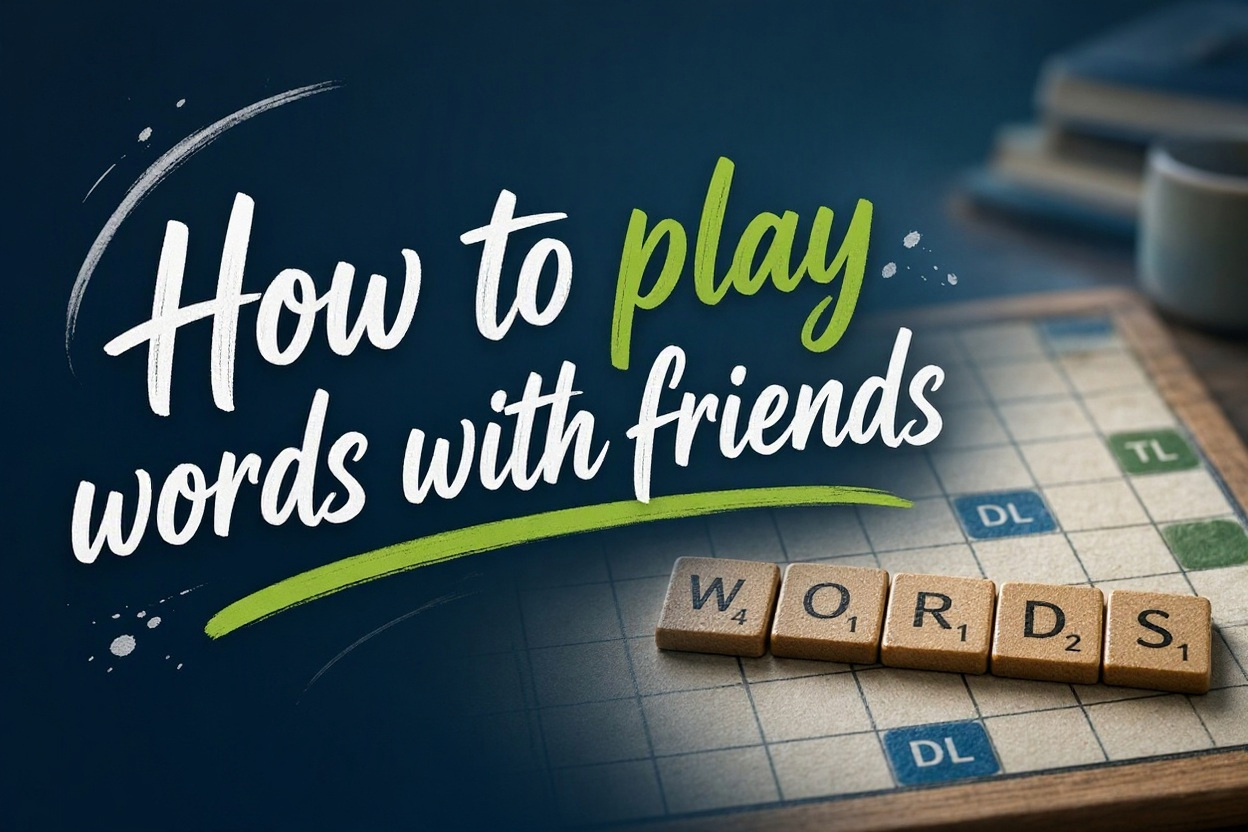
Learning how to play Words With Friends is easy and fun once you understand the basic board, tiles, and scoring system behind this classic mobile word game.
If you are new to how to play Words With Friends, you start with seven letter tiles, place your first word on the center star, and then take turns building crossword-style words to earn points. Each letter has a point value, and bonus squares for double letter, triple letter, double word, and triple word can turn a simple play into a high-scoring move.
In this complete guide, you will learn the rules, setup, scoring, strategies, common mistakes, expert tips, and practical examples that will help you play with confidence. Whether you want casual games with family or competitive matches with skilled opponents, this walkthrough covers everything from your first move to advanced winning tactics.
By the end, you will know exactly how to play Words With Friends smartly, score more points consistently, use power-ups wisely, and enjoy every match while steadily improving your vocabulary and board vision.
Words With Friends is a turn-based crossword game where two players alternate placing words on a fifteen by fifteen board. Your goal is to finish with more total points than your opponent when all tiles are used and no moves remain.
The game feels relaxed because you do not need to play live. You can take your turn, close the app, and return later when your friend plays back, which makes it perfect for busy schedules and long-distance friendships.
Each match starts with randomly drawn tiles, and luck matters at first. Over time, however, strategy matters much more than luck, because smart positioning, tile management, and defensive play decide most close games.
New players often focus only on long words, but experienced players focus on points per turn, board control, and leaving no easy openings. That shift in thinking is what separates beginners from consistent winners.
The good news is that you can improve quickly by learning tile values, bonus squares, opening principles, and simple defensive habits. With a little practice, your average score and win rate will rise noticeably.
How Does Words With Friends Work?
1. Game Setup And Starting Your First Match
To start learning how to play Words With Friends, install the app, create an account, and tap create game to invite a friend by username or let the app find a random opponent for you. Once the match begins, you receive seven random letter tiles on your rack, and the player who moves first must place a word covering the center star square. That first word must use at least two letters, and every word you play must connect to existing words in crossword fashion, reading left to right or top to bottom.
2. Letter Tiles Values And Tile Distribution
Each tile in how to play Words With Friends has a fixed point value based on letter rarity, with common letters like E, A, I, O, and S worth one point and rare letters like Q, Z, J, and X worth eight to ten points. There are 104 tiles total, including blank tiles that act as wildcards worth zero points but can represent any letter you need. Understanding which letters remain unseen helps you plan future plays, save useful combinations, and decide when to exchange weak tiles instead of making a low-value move.
3. Board Layout And Bonus Squares Explained
The Words With Friends board contains special bonus squares that multiply letter or word values, including double letter, triple letter, double word, and triple word squares placed symmetrically across the grid. A double letter doubles only the tile placed on it, while a double word doubles the entire word score after letter bonuses are applied. Triple word squares are the most powerful because they triple the whole play, so controlling access to them and timing your high-value letters for those spots is essential for winning competitive games.
4. Forming Valid Words And Making A Move
On each turn when you play Words With Friends, drag tiles from your rack onto the board to form one main word, and all adjacent letters must also create valid side words in the opposite direction. Once you are happy with placement, submit the move and the game dictionary checks every new word automatically for validity. If all words are accepted, your points are added, your used tiles are replaced with new ones, and play passes to your opponent for their turn in the same connected style.
5. Scoring Points And Bonus Tile Plays
Scoring in how to play Words With Friends adds the face value of each new tile, applies any letter bonuses first, then applies word multipliers for the whole turn, which means stacking multiple word bonuses creates huge swings. If you use all seven tiles in one turn, you earn a thirty-five point bingo bonus in addition to the word score, which often decides close matches. Careful players also score extra points from parallel plays that create several short side words at once, especially near existing words with high-value letters.
6. Swapping Tiles Passing And Ending The Game
If your rack has difficult letters like too many vowels, too many consonants, or an unplayable Q without U, you can swap some or all tiles instead of playing, but you lose that turn while your opponent scores. You may also pass if no swap is helpful, although passing repeatedly is rarely wise because it gives free momentum to the other player. The game ends when the tile bag is empty and one player uses all remaining tiles or both players pass consecutively, and leftover tiles in each rack are subtracted from final scores.
7. Solo Play Practice Mode And Game Options
Beyond live matches, how to play Words With Friends includes solo practice against computer opponents at different difficulty levels, which is ideal for testing openings, learning new words, and building speed without pressure. You can usually play multiple games at once, chat with friends during matches, and use built-in tools like tile bag view, word strength meter, and move undo before submitting. Exploring settings for notifications, board themes, and dictionary options helps you create a comfortable routine that supports steady improvement over many games.
Key Rules For Words With Friends Play
1. Your first word must cover the center star square and contain at least two letters to start the game legally.
2. Every later word must connect to at least one existing tile and all newly formed side words must be valid dictionary words.
3. Blank tiles can stand for any letter you choose, but they always score zero points wherever they are placed.
4. You cannot play proper nouns, abbreviations, hyphenated terms, or words requiring apostrophes because the dictionary will reject them.
5. Using all seven tiles in one turn earns a thirty-five point bingo bonus in addition to your normal word score.
Best Tips To Win Words With Friends
- Control Bonus Squares: Always think two moves ahead and avoid opening triple word lanes unless you score more from them immediately than your opponent could on the next turn.
- Save High Value Letters: Keep J, Q, X, and Z for double letter, triple letter, or parallel plays where their face value multiplies into twenty points or more.
- Learn Short Words: Memorize useful two and three letter words with J, Q, X, and Z because they unlock tight spots and create valuable parallel scoring chances.
- Balance Your Rack: Aim for a mix of three to four consonants and three to four vowels after each play to keep future word options flexible and open.
- Play Parallel For Points: Place words alongside existing words to form multiple short cross words at once, since those stacked points often beat one long word.
- Block Opponent Openings: Close easy access to triple word squares with short blocking words when you cannot use those premium squares yourself right away.
- Track Remaining Tiles: Check the tile bag often to know if key letters are still available and to plan endgame plays that trap extra points.
Common Mistakes In Words With Friends
1. Wasting Triple Word Opportunities Too Early
Many beginners learning how to play Words With Friends rush to grab any open bonus without calculating the trade-off, placing a low-scoring word that opens a better lane for the opponent. Instead, wait until you have a high-value letter or a bingo setup that truly justifies opening that area. If you cannot score strongly yourself, play elsewhere and keep the premium square closed until your rack improves and the timing favors you.
2. Holding Difficult Tiles For Too Long
Holding Q, V, C, or duplicate letters for many turns while hoping for the perfect word often costs more points than it gains in how to play Words With Friends. Each weak turn lets your opponent build a lead and control the board while you stay stuck with the same problem rack. Learn when to dump ten to fifteen points now and refresh your tiles rather than waiting five turns for a thirty point play that may never appear.
3. Ignoring Defense And Board Control
Offense alone rarely wins when you play Words With Friends against thoughtful opponents, because every open triple word lane is an invitation for a huge comeback. Before playing a word, ask what premium squares it opens and whether your opponent has likely tiles to exploit them. Simple defensive habits like blocking hot spots, avoiding easy parallel hooks, and keeping the board tight will save you far more points than one flashy high score.
4. Playing Long Words Instead Of High Scores
A seven-letter word is not automatically better than a four-letter word in how to play Words With Friends, because placement and bonuses matter more than length. A short word like ZAX on a triple letter square can outscore a long common word played on plain squares by a wide margin. Train yourself to compare total points, future rack balance, and board safety rather than admiring word length alone when choosing each move.
5. Forgetting Two Letter And Short Words
Players who do not study short words miss many scoring chances and often think they have no move when several strong options exist on a crowded board. Words like JO, QI, ZA, XI, AX, and EX are fully valid and incredibly useful for tight corners, parallel plays, and dumping tough letters efficiently. Spending a little time learning common two and three letter words will immediately raise your average turn score and reduce frustrating swaps.
6. Poor Endgame Planning And Tile Counting
The final six to eight moves decide many close games, yet beginners often ignore the tile bag and remaining opponent tiles when they play Words With Friends. Failing to count tiles leads to trapped high-value letters, missed out-plays, and losing points from leftover tiles at the end. Watch the tile tracker, plan to go out first when ahead, and save a flexible consonant-vowel mix so you can finish cleanly even on a messy late board.
7. Overusing Power-Ups Without Real Strategy
Helpful features like hindsight, word radar, and swap plus can support learning how to play Words With Friends, but relying on them for every difficult decision prevents real skill growth and wastes resources. Power-ups work best when used sparingly for genuinely stuck positions or to confirm a close choice between two good plays. Focus first on fundamentals like rack balance, bonus control, and short-word knowledge, then use boosts only as occasional support rather than a crutch.
Mastering how to play Words With Friends comes down to simple habits done well, including starting strong on the center star, using bonus squares wisely, balancing your rack, and defending triple word lanes.
As you practice short words, parallel plays, tile tracking, and endgame planning, you will notice higher scores, fewer wasted turns, and much more confidence in close matches.
Keep playing regularly, review your best and worst moves after each game, and challenge slightly stronger opponents to sharpen your board vision even faster.
With patience and smart strategy, every match becomes more enjoyable and rewarding, whether you play casually with friends or aim to climb into competitive winning streaks.
FAQs About How To Play Words With Friends
How Do Beginners Start Playing Words With Friends?
Beginners should create an account, start a game with a friend or practice bot, and focus on covering the center star with a solid first word. Keep seven tiles balanced, play shorter high-value words first, and avoid opening triple word squares for your opponent while you learn basic scoring.
What Is The Highest Scoring Strategy In Words With Friends?
The highest scoring strategy combines bingo plays using all seven tiles, parallel plays that create multiple words, and saving J, Q, X, and Z for triple letter or triple word squares. Consistent winners also manage rack balance carefully and block opponent access to premium bonus lanes throughout the game.
Can You Play Words With Friends With Random Opponents?
Yes, you can start smart match or random opponent games if friends are unavailable, and the app pairs you with players near your skill level. This is a great way to practice different styles, learn new words, and gain experience quickly because you can play several turn-based games at the same time.
What Words Are Not Allowed In Words With Friends?
Proper nouns, abbreviations, standalone prefixes, suffixes, hyphenated words, and words needing apostrophes are not allowed in Words With Friends. All plays are checked against the official game dictionary, so slang may be accepted only if it appears in that word list.
How Do Blank Tiles Work In Words With Friends?
Blank tiles act as wildcards that can represent any letter from A to Z, which helps you complete bingos and connect difficult board positions. They score zero points themselves, but the words they help create still earn full value, so save blanks for high-scoring bingo opportunities whenever possible.
How Can I Improve Quickly At Words With Friends?
To improve quickly, study two and three letter words, practice parallel plays, review tile values, and track remaining tiles in the bag. Play daily, analyze losses for defensive mistakes, save power letters for bonus squares, and focus on points per turn rather than just making long words.